stationery of murder before evensong
Never underestimate the ice-breaking power of stationery.
-Canon Daniel Clement
Kat and I just finished the tv series Murder Before Evensong, based on the novel of the same name by the Reverend Richard Coles. And boy, did it keep this stationery nerd on the edge of his seat. Set in a rural English village in the 80’s, stationery is seen, used, and discussed throughout the series. It’s even a key point in the plot (but I’ll try to keep spoilers out of this review).
I enjoyed writing about the stationery in Ludwig so much, I couldn’t resist doing the same for Murder Before Evensong. Let’s get into it!
Daniel’s Stationery
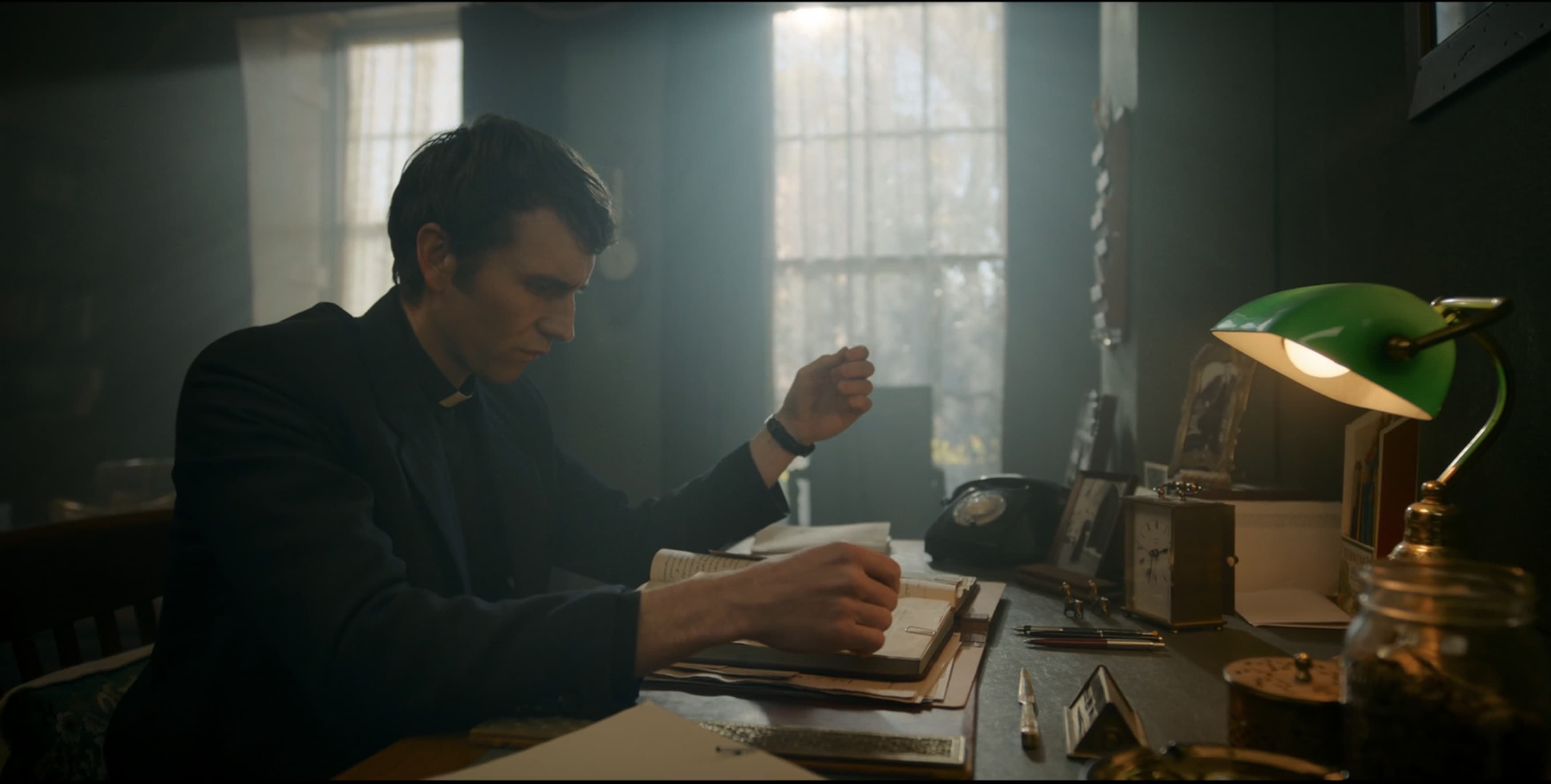
The Canon is a stationery fan, as we can see from his writing desk throughout the series. He covers all the bases at his desk, with a fountain pen, Parker Jotter, and what looks to be a drafting pencil. What more do you need than a fountain pen, ballpoint and pencil. If only I could keep my setup that concise…
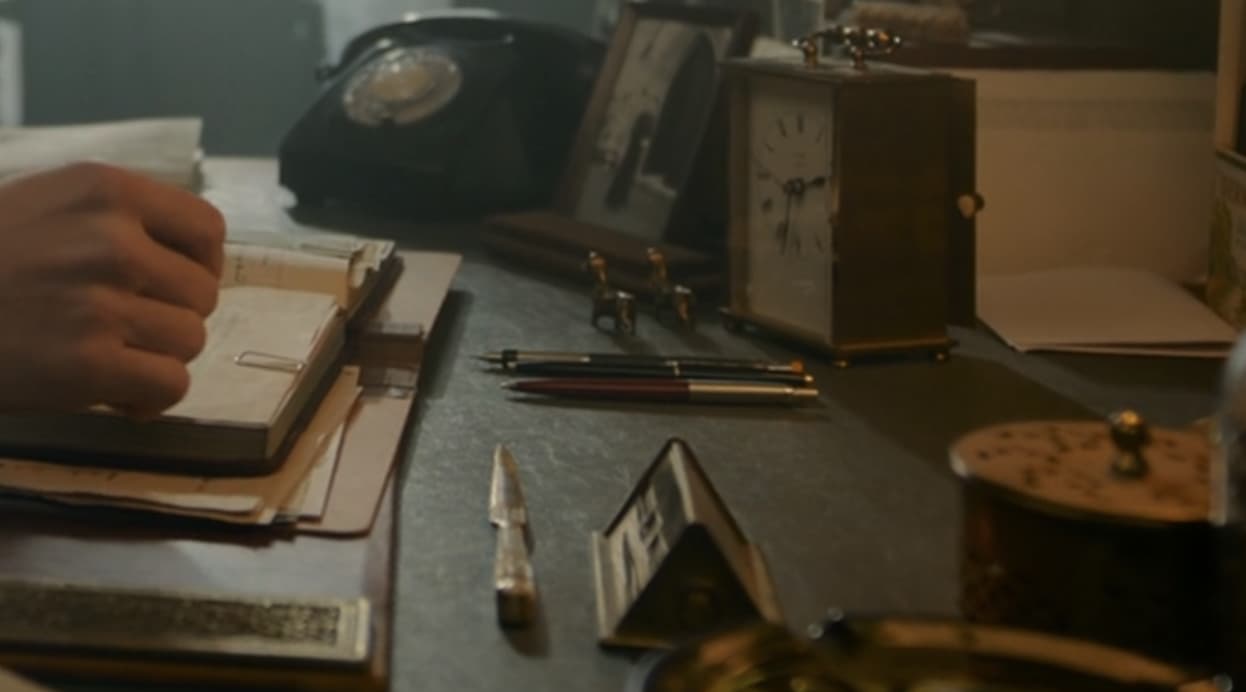
The pencil on the desk looks like it could be a Pentel Graphlet, a PG509 based on the color of the cap (more on pencils later).
Now the fountain pen and ink are quite interesting. The ink is Registrar’s ink, i.e. a very specific blue-black iron-gall ink. I’ve known of Registrar’s ink, but didn’t know anything about its history. Registrar’s ink - because of its permanent, waterproof properties - was used for official documents, one of which being entering births and marriages into a church registry. Neat!

According to the show - at least in the 80’s - it also wasn’t widely available to anyone (maybe as a means of protection against forgeries?). It was available to church folk, lawyers and the sort. But it had to be special ordered. The classic options for Registrar’s ink is England’s own Diamine Registrar’s or ESS (Ecclesiastical Stationery Supplies) Registrar’s Ink. But looking at the bottle from which Daniel fills his pen, I would guess he’s using Parker Registrar’s ink, a potentially odd choice to use the ink of a (then) US-based company rather than the I’m sure preferred and more affordable local variety.
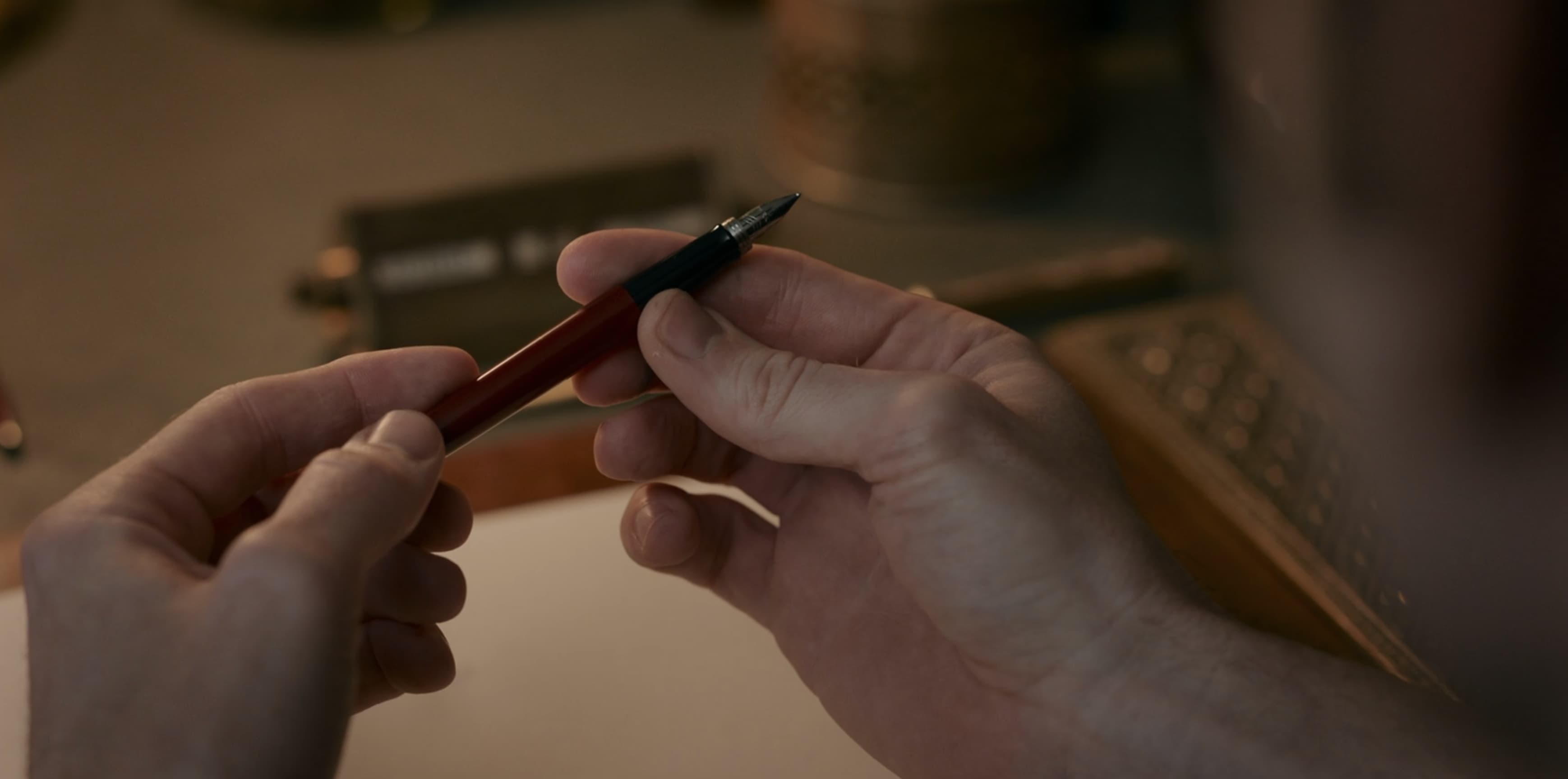
There are two fountain pens seen - the black one on the desk and the red one Daniel uses to write his sermons. From my research into Registrar’s ink I stumbled across the Parker Registrar’s pen (1 and 2). This is likely the pen on the desk and used in conjunction with the ink. Iron gall ink can be corosive (I think it’s dangers are overexaggerated, but it can do damage to pens), so best to not use it in the nice pens.
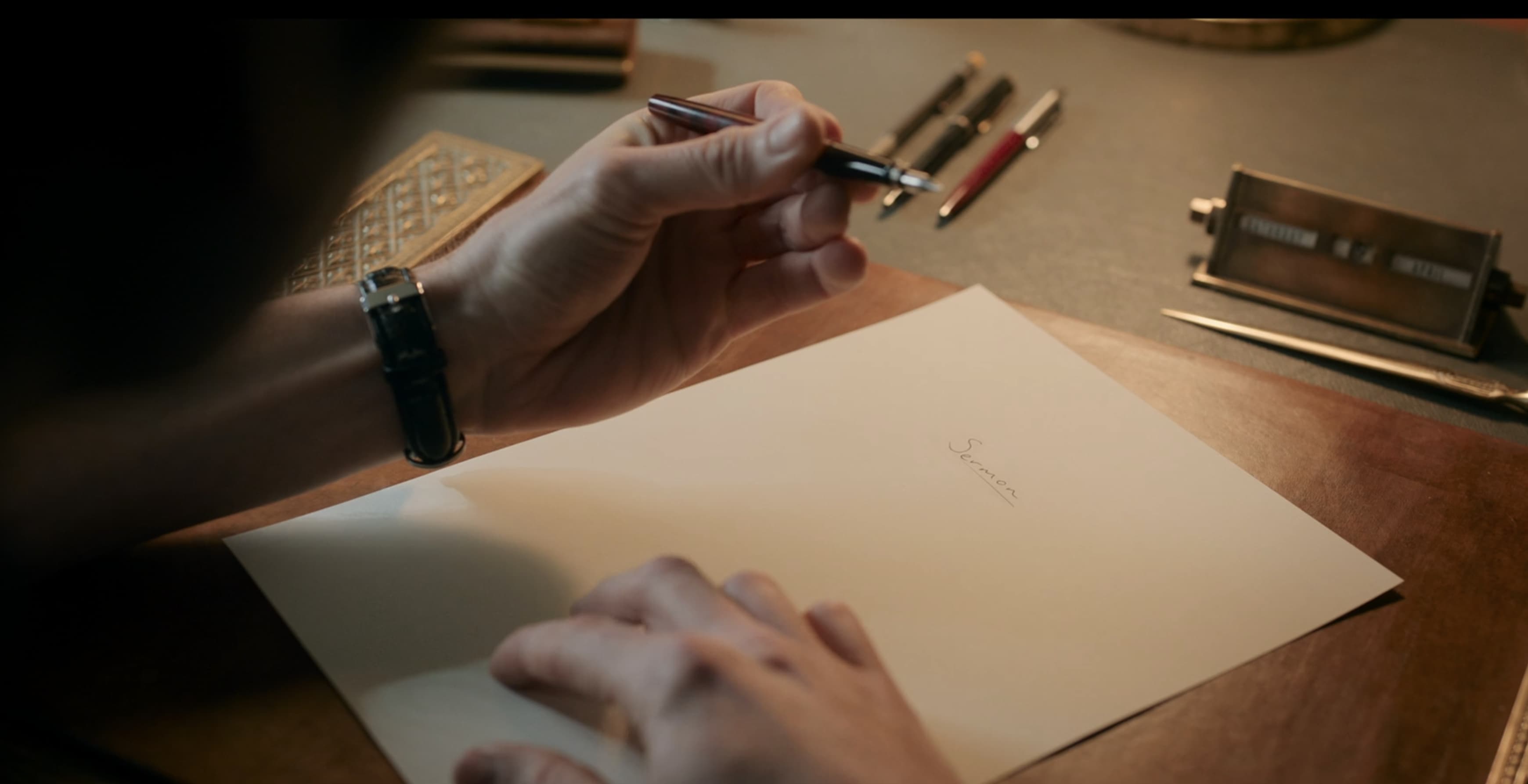
The red fountain pen was his Father’s, so likely from the 70’s or 60’s. It’s hard to ID it, but it has a snap closure and is a cartridge/converter. Mr. Rene on the Fountain Pen Network identifies it as a Parker Jotter (Fountain Pen variety) and I find his evidence compelling. Maybe it’s part of a matching set with the Jotter ballpoint on his desk - both red.
Anthony’s Stationery

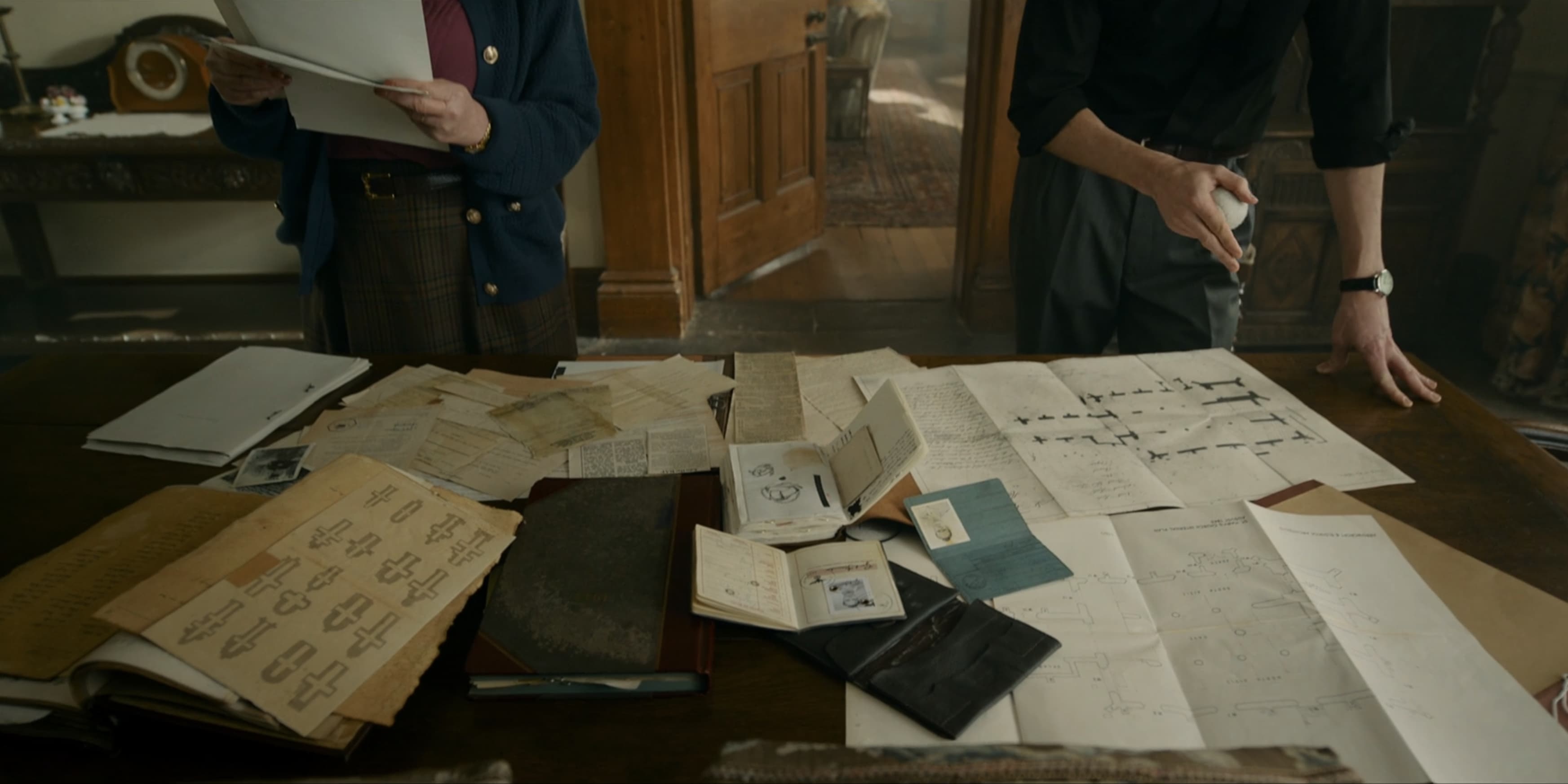
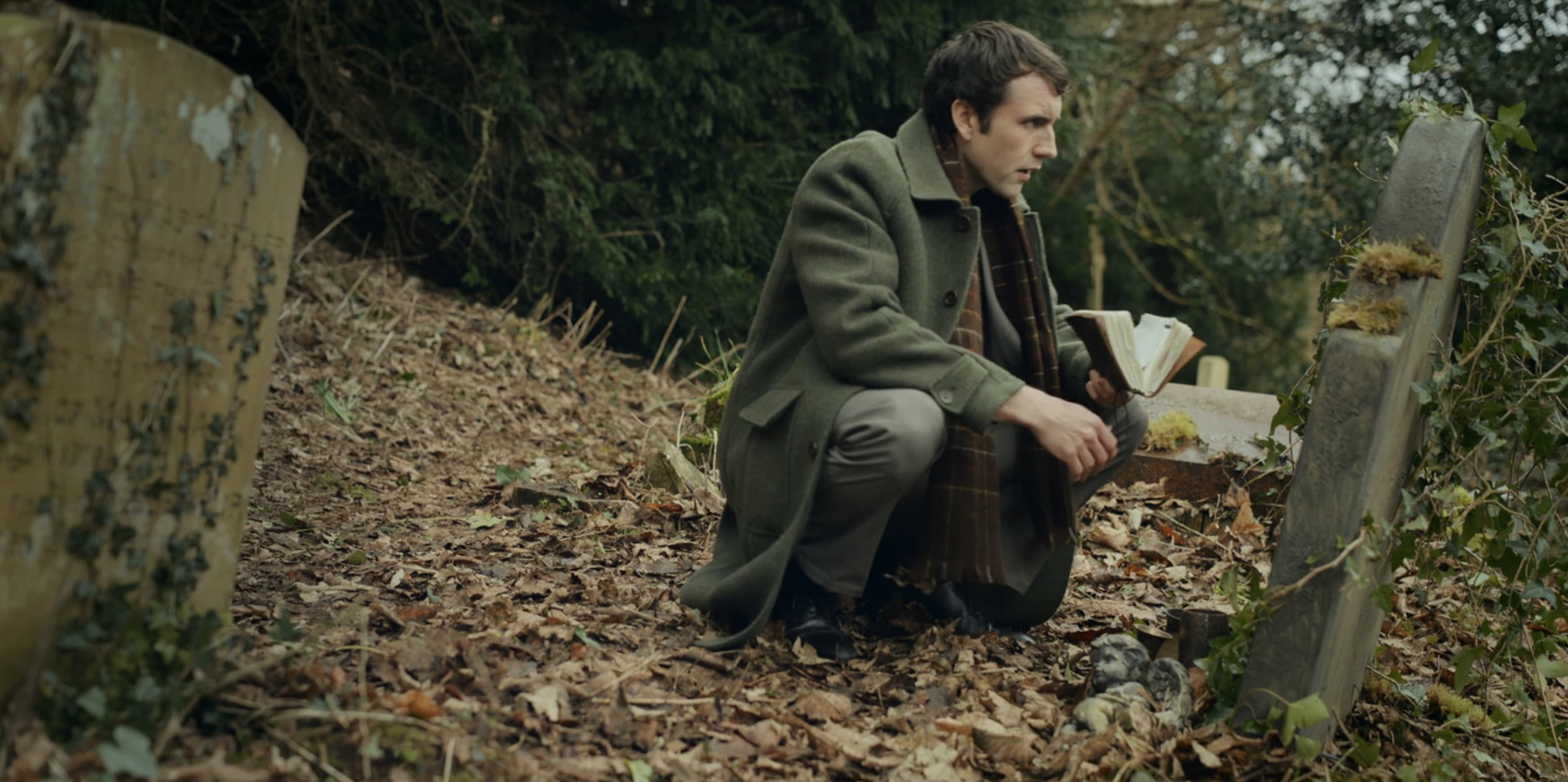
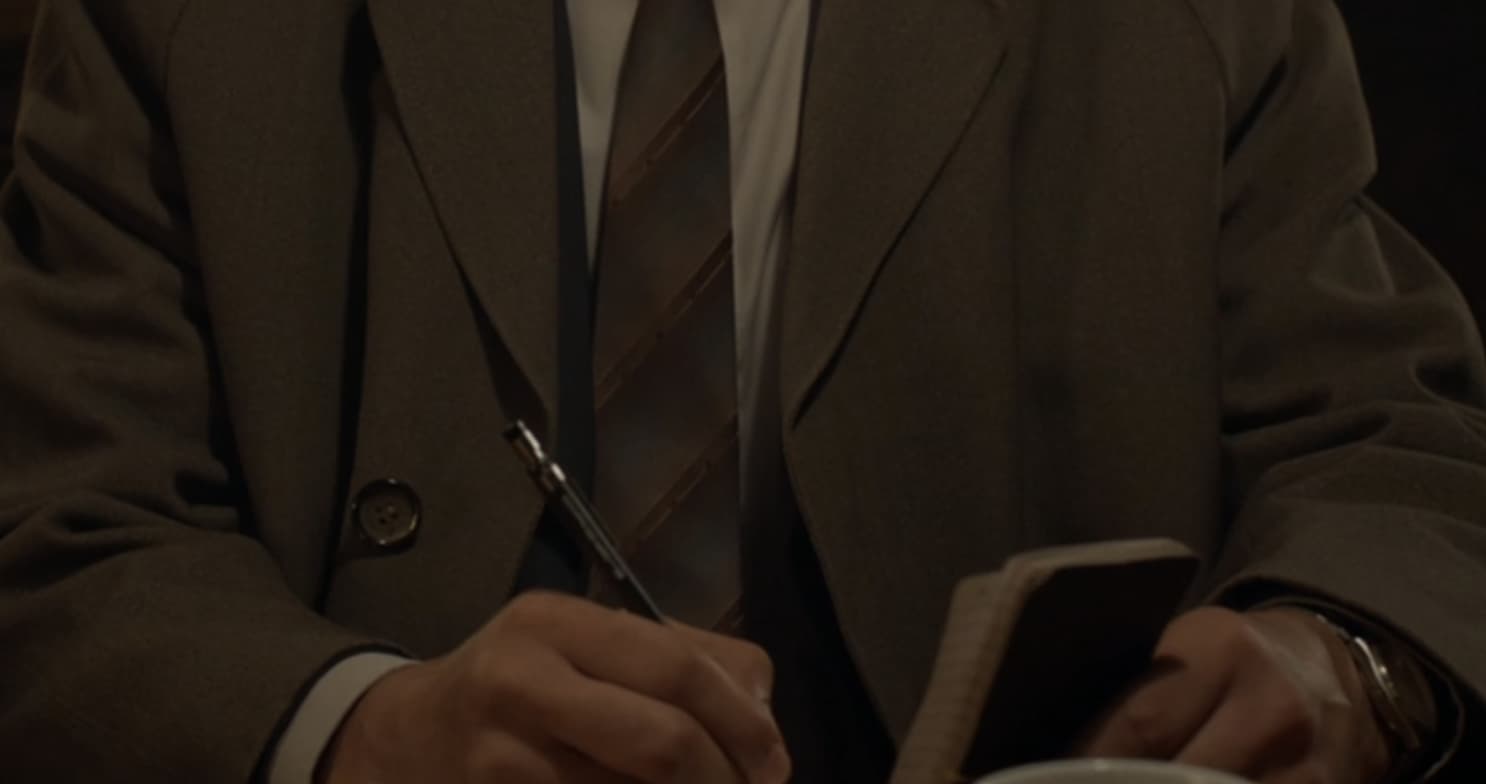
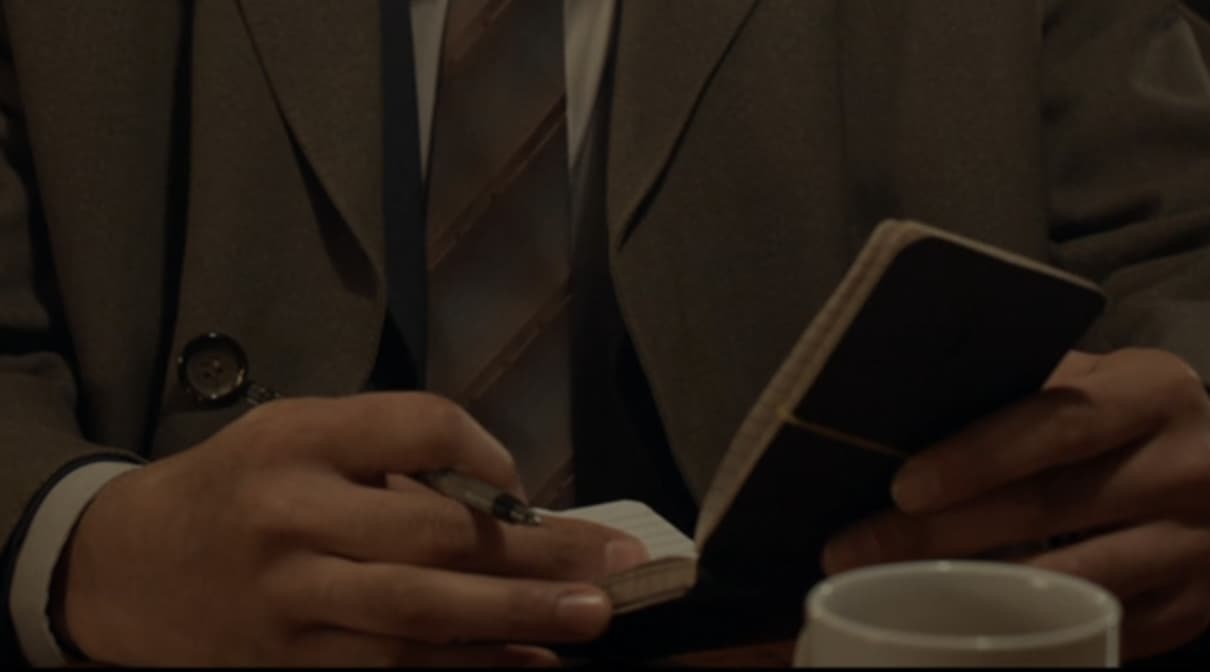
The key item in Anthony’s stationery is his notebook. It’s a classic Traveler’s Notebook style notebook 1 - leather cover that can fit multiple notebooks inside, secured by rubber bands. His is chock full of notes, drawings, thoughts, theories and conspiracies. A veritable treasure chest. It’s fun to see Daniel flipping through this notebook throughout the series 2.

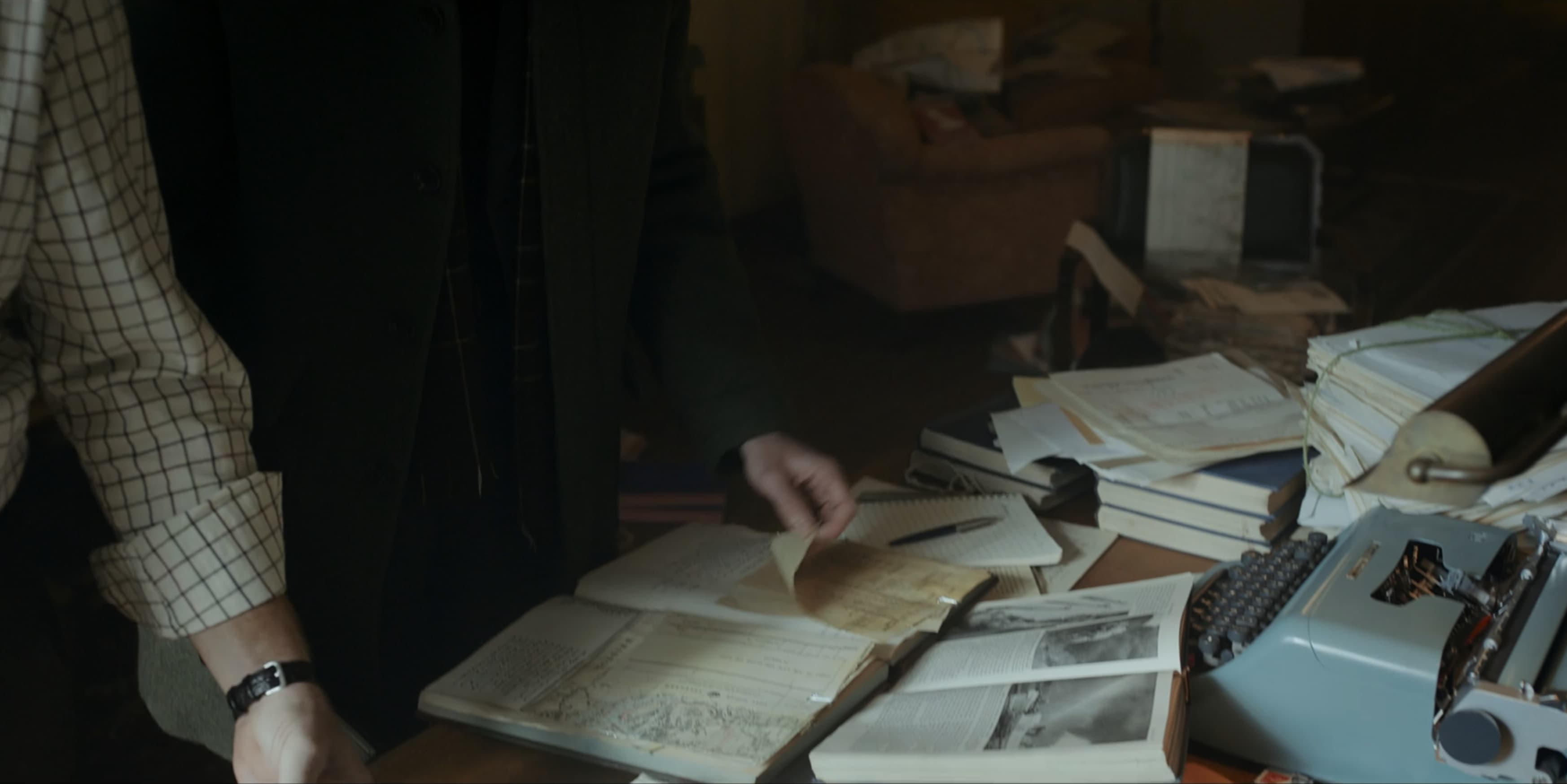
We can see Anthony was also a Parker Jotter user, there’s one lying about in his office at the Manor house. And he must have had another pen, based on the writing in the notebook - either a rollerball or fountain pen. More likely fountain pen based on the line variation he gets.
DS Vanloo’s Stationery
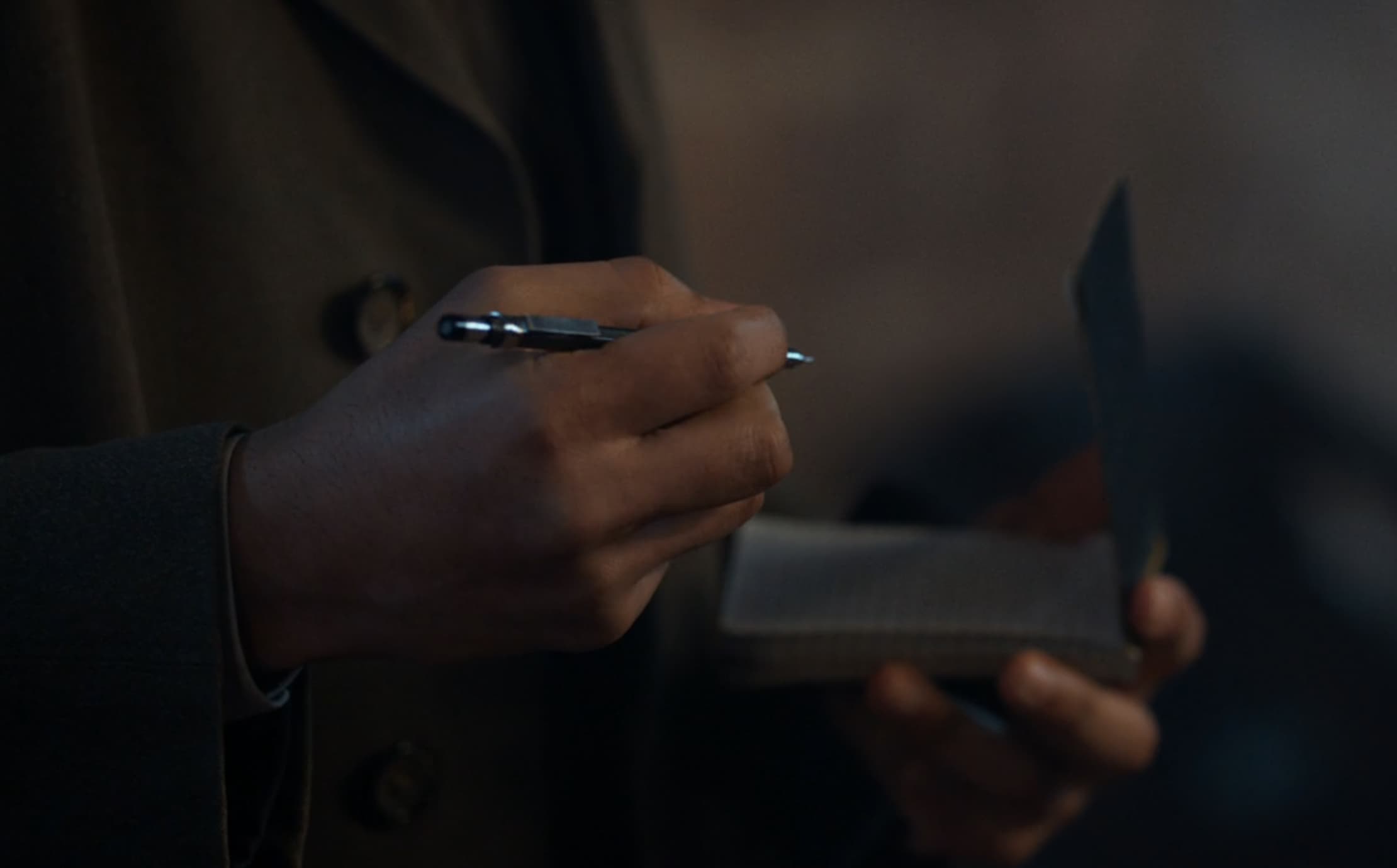
There’s not too much here, he has a drafting pencil and he uses that to mark graphite onto a reporter’s style flip notebook. A classic detective setup, I bet the office supply cabinet at every nick is stock full of these notebooks. I wouldn’t trust an English detective using anything else.

While the notebook is probably standard office supply fodder, the pencil is a bit special and must be a personal preference. Which leads us to the pencil.
The Pentel P205
I have a nit to pick with this pencil. It gave me a bit of annoyance, but it led to a lot of research and I learned a few neat things along the way so I want to talk about it.
When Daniel first meets DS Vanloo, he compliments him on the mechanical pencil he is using, the Pentel P205. Except…it’s not a P205. It is a similar pencil, but it is not the P205 3.
I love the Pentel P series drafting pencils and own a Pentel P207 myself (I’ve had it since college…maybe even high school? It doesn’t see as much use these days, but I wrote many a proof with it back in the day). So I could tell the pencil wasn’t quite right and couldn’t help digging (probably too deep) into it.
While the P205 is historically accurate writing instrument- it was first manufactured sometime in the 1970’s - the shape (especially around the knock and the grip) just doesn’t match up. I have looked up some vintage P205s from the 70’s in case the design changed; but nae, that design hasn’t changed a lick in 50 years.
After a fair bit of research, I’m fairly confident the pencil is a Pentel Graph 500 (PG505), now known as the Pentel Graphlet. It has the black tip at the end of the knock, the clips look similar, as does the knurling. The PG505 was released some time in the 80s (having trouble pinning down an exact year), so it is also historically accurate. I think the money-shot would be if we could see the lead indicator on the knurling in the series. Alas, it is never visible. But even without that confirmation, I’m confident in its ID.
Another possibility was the Alvin Draft/Matic (DM05), but the knocks don’t match up as neatly. This was my first guess, but Kat’s quick research led us to the Graphgear (PG525) and subsequently the Graphlet (PG505).
I hope this isn’t making too big of a deal about the mismatch - I think it’s awesome that stationery is getting featured in TV shows and getting these things accurate is hard 4. They could have easily cut the scene and we would missed out on some stationery goodness.
One final note about drafting pencils - I learned that the colors of drafting pencils (and technical pens) is governed by ISO 128. Yellow for lead/nib width of 0.35mm, brown for 0.5mm, blue for 0.7, orange for 1.0mm. This has relaxed a little bit, where say yellow covers 0.35mm and 0.3mm, orange can also represent 0.9mm lead and black is often used for 0.5mm as well. But that explains why the P205 is black and the P207 is blue!
It makes sense that they would do this. Back in the day when drafting was done by hand, you had to swap between different width pen(cil)s frequently, so the color coding makes it much easier to grab the right one. I just think it’s so cool - I love seeing all these details that existed in a world before computers. All these well thought out details that make life easier - detail that’s kind of lost now that you can change font weight with a hotkey on your computer5. We often talk about making jigs in software development, little tooling that makes manual process less monotonous or error prone - well, we didn’t come up with that idea.
So yeah, there was a lot of stationery in the show and it certainly was fun to do some research into it. I hope they continue to adapt the Rev’s other novels into the series and that we can see more 80’s stationery.
-
though not a Traveler’s brand one - those didn’t exist until the 2000’s. But that style existed long before the company. ↩
-
tv shows are going to be so boring in the future if they find someone’s old iPhone and flick through that for evidence instead of something analog like a notebook. And because everything’s in the cloud it probably wouldn’t even be feasible to flip through someone’s phone 20 years after its use. If it even turns on at all. Notebooks fucking rule. ↩
-
we should all take a moment to appreciate the photos on the blog. ↩
-
I spent many happy hours going down the drafting pencil rabbit hole. ↩
-
we see this a lot with watches too - dive watches have the rotating bezel for a timer, GMT watches have a second hour hand. They’re cool details now but served real purposes when you didn’t have a phone with a timer and automatically adjust for timezones. ↩